Welcome to Core Physio: Home of Equestrian Performance
Services
My work is built around a clear principle: treat the system, not just the symptom.
Horse and rider are assessed both individually and together, using a combination of clinical physiotherapy, biomechanics, and performance testing to create meaningful, lasting change.
I work with high performance riders, as well as committed amateur riders and horses, while also maintaining a strong clinical caseload of non-riding patients with everyday musculoskeletal conditions.
Equine Physiotherapy
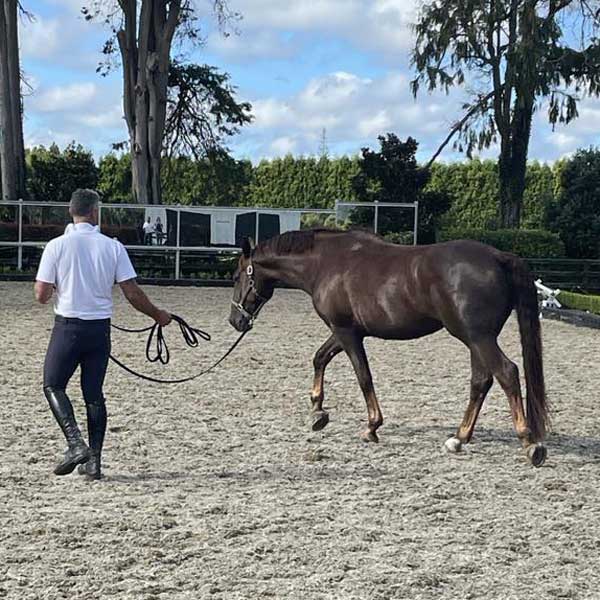
Equine physiotherapy is a core part of my practice. Each horse is assessed as an individual athlete, with a focus on movement quality, comfort, and functional capacity.
Assessment and treatment may include:
- Detailed observation of movement in walk and trot
- Identification of asymmetry, restriction, and compensatory patterns
- Palpation and assessment of soft tissue and joint function
- Treatment of musculoskeletal dysfunction and injury
- Rehabilitation planning following injury or performance decline
The goal is to restore efficient, comfortable movement, allowing the horse to perform without unnecessary strain and to maintain long-term soundness.
Research & Evidence in Practice
My clinical approach is underpinned by research, including my Master’s thesis, which investigated the effects of an 11-week physiotherapy intervention on the distance between the interspinous spaces of the thoracic spine in horses.
This work explored whether physiotherapy could influence resting spinal posture, with particular relevance to horses presenting with or at risk of overriding dorsal spinous processes (kissing spines).
The intervention programme incorporated:
- Manual therapy
- Dynamic mobilisation exercises
- Targeted stretching
The findings demonstrated that measurable increases in interspinous distance were possible, suggesting that physiotherapy may play a meaningful role in modifying spinal mechanics and improving comfort in affected horses.
This study was supported by collaboration with Narelle Stubbs, the physiotherapist involved in developing the Equiband system, a widely used dynamic training aid designed to enhance core activation and postural control in horses.
Application to clinical practice
Building on this work, I incorporate evidence-informed approaches using dynamic stabilisation systems such as Equiband / Equicore, which are designed to:
- Facilitate activation of the thoracolumbar stabilising musculature
- Improve postural control and trunk support
- Encourage more efficient movement patterns
- Support rehabilitation and performance development
Current evidence and clinical use suggest these systems can assist in improving core engagement, back function, and movement quality, particularly when combined with skilled physiotherapy assessment and treatment.
This integration of research, clinical reasoning, and practical application ensures that interventions are not only effective, but grounded in a deeper understanding of equine biomechanics and function.
Rider Physiotherapy
On-horse (ridden assessment)
Ridden assessment is where the interaction between horse and rider becomes most visible.
Sessions involve:
- Observation of rider position, symmetry, and coordination
- Analysis of how rider movement influences the horse
- Identification of inefficiencies affecting performance or comfort
- Real-time feedback to improve communication and effectiveness
This is particularly valuable for riders experiencing:
- Performance plateaus
- Asymmetry or instability in the saddle
- Difficulty influencing specific movements or transitions
Off-horse (clinic-based – Muriwai)
Clinic sessions in Muriwai focus on the rider as an individual, using advanced musculoskeletal physiotherapy assessment and treatment.
This includes:
- Assessment of strength, mobility, and motor control
- Identification of impairments contributing to riding issues
- Treatment of pain and injury (acute or persistent)
- Individualised rehabilitation and performance programmes
Rider Performance Simulator
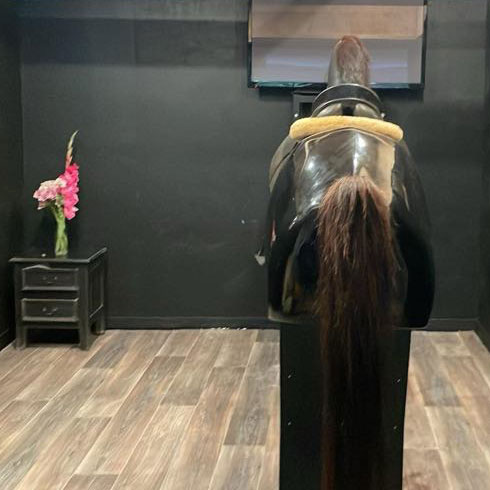
A defining feature of my practice is the use of a Racewood dressage simulator, offering a level of assessment and training rarely available.
This is the only simulator of its kind in the North Island, and the only one in New Zealand owned and operated by a physiotherapist.
The simulator allows:
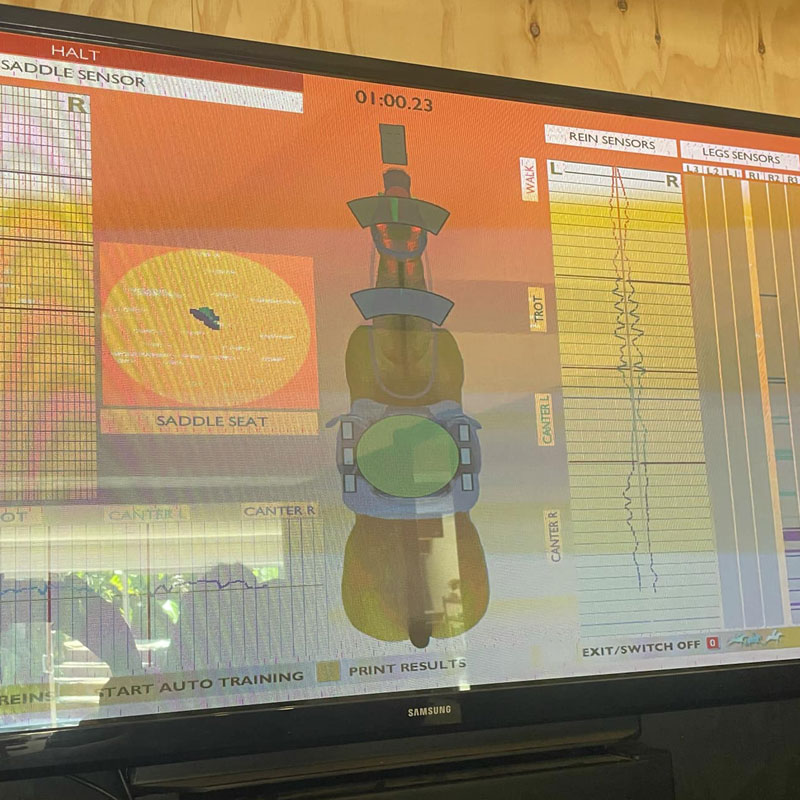
Precise assessment of rider symmetry and posture
Analysis of pelvic control through all gaits
Measurement of rein contact consistency
Removal of horse-related variability to isolate rider factors
It is particularly powerful for:
Injury rehabilitation
High-performance refinement
Developing coordination, timing, and feel
Objective reassessment over time
I am also ACC accredited, and treat a wide range of non-riding patients with conditions such as:
- Low back pain
- Tendinopathy
- Shoulder injuries (including rotator cuff)
- Sprains and general musculoskeletal pain
This ensures riders receive the same high-level clinical care as any elite athlete, while also offering expert physiotherapy to the wider community.
Pilates Integration
I am certified in Mat Pilates, which I integrate directly into rider rehabilitation and performance programmes.
Pilates provides a highly effective framework for developing:
- Core strength and control
- Balance and body awareness
- Postural alignment and coordination
These qualities are fundamental to an effective rider, directly influencing stability in the saddle, clarity of aids, and the ability to move with the horse rather than against it.
As part of this, I also run rider-specific Pilates sessions, applying these principles in a way that translates directly to riding performance. Sessions are structured to complement both clinical rehabilitation and ongoing performance development.
Rider Pilates Classes
Weekly mat-based rider Pilates sessions are held in Waimauku (Tuesday evenings), designed to build strength, symmetry, and control in a way that directly carries over into the saddle.
Objective Performance Testing – Hawkin Trustrength
A key component of my assessment process is the use of Hawkin Trustrength, a gold standard handheld dynamometry system used internationally in high-performance sport.
This state-of-the-art technology allows objective measurement of:
- Muscle strength
- Side-to-side symmetry
- Force production and control
- Power output
This moves assessment beyond observation alone, providing quantifiable data to guide treatment and track progress.
The system was developed by Professor John Cronin, a globally recognised leader in strength and conditioning and biomechanics. His work has been instrumental in advancing how athletes are tested and trained, and Hawkin Trustrength reflects that same high-performance standard.
Integrating this technology into rider assessment allows:
- Precise identification of deficits impacting performance
- Targeted, individualised programming
- Clear, measurable outcomes over time
Functional Movement Screening
Alongside dynamometry, I use functional movement screening to assess how riders move as a whole system.
This helps identify:
- Movement pattern inefficiencies
- Stability and control deficits
- Mobility restrictions affecting performance
These findings are then integrated into rehabilitation and performance programmes, ensuring that improvements translate directly into riding.
An integrated system approach
What makes this practice distinctive is how all elements are combined.
Horse. Rider. System.
Each component informs the other:
- Equine assessment highlights how the horse is coping
- Rider assessment identifies contributing factors
- Simulator and strength testing refine understanding
- Treatment is targeted at the true driver of dysfunction
This integrated model allows for:
- More accurate diagnosis
- More effective intervention
- Better performance outcomes
- Improved long-term wellbeing for both horse and rider
The Core Physio Approach
1.
On Horse Rider

.
2.
Off Horse Rider

3.
Horse
Riding Simulator
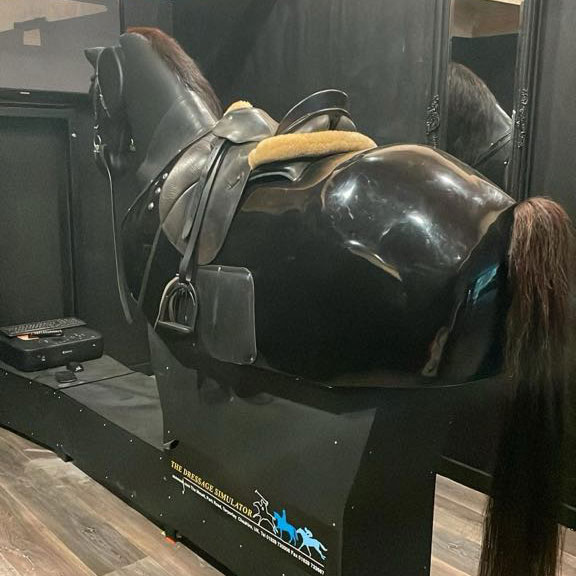
The Racewood Dressage Simulator is the only one in the North Island of New Zealand. Made in England, this highly specialised piece of equipment is the size of a real horse and gives real-time feedback to the rider on their weight distribution, leg pressure and rein tension via sensors.
The horse can be ridden through the gaits and rider symmetry is shown on the computer screen in front. You can even ride a dressage test in the arena and practice flying changes, half pass, piaffe and passage, so you can practice all the movements to be a Grand Prix rider!!!
Physiotherapy Interventions for Horse and Human
Treatment is always individualised, based on a detailed clinical assessment and a clear understanding of what is driving pain, dysfunction, or performance limitation.
Interventions may include:
Targeted, tailored strength and rehabilitation programmes designed to restore capacity, improve resilience, and support performance
Manual therapy, including joint mobilisations and manipulation, to improve movement and reduce pain
Soft tissue therapy and massage to address muscle tone, restriction, and recovery
Dry needling to assist with pain modulation and muscle function
Laser therapy to support tissue healing and inflammation management
Taping techniques to assist with movement, support, and symptom modification
These approaches are integrated with movement retraining and education, ensuring that treatment translates into meaningful, lasting improvements in function.